How to Learn to Code in 2026: A Realistic Roadmap
A no-hype learning path for beginners in the AI era: what to learn, in what order, how long it really takes, and how to use AI as a tutor instead of a crutch.

Hugo Nina
Founder & Editor
Marcus Webb
Fact Checked
Type “should I learn to code in 2026” into any search box and you’ll drown in contradictions: AI is replacing programmers; there’s never been a better time; bootcamps are dead; developers are still among the best-paid professionals on earth. Somewhere under the noise, real people — career changers, students, curious adults — just want a straight answer and a workable plan.
Here’s the straight answer: yes, it’s worth learning — and the way to learn has genuinely changed. The AI era didn’t make coding skills obsolete; it raised the bar on which skills matter (understanding, debugging, judgment) while handing beginners the best tutor humanity has ever produced. What follows is the realistic roadmap: what to learn, in what order, with honest timelines.
First, calibrate expectations
Three truths to set the frame:
- The entry-level market is genuinely competitive. Junior hiring tightened through the mid-2020s, partly because AI absorbs junior-shaped tasks (we cover the data in our salaries and remote work report). People still get hired every day — but “finished a bootcamp” stopped being sufficient years ago.
- The timeline is 12–24 months, part-time, to employability. Anyone selling twelve weeks is selling something. Consistency (an hour-plus daily) beats intensity (weekend binges) by a wide margin because programming skill is memory consolidation, and consolidation needs sleep cycles, not heroics.
- The skill that pays is not syntax. AI writes syntax. The durable skill is the loop underneath: decompose a problem → attempt a solution → read the failure → adjust. That loop is learnable by anyone patient, and it’s exactly what this roadmap trains.
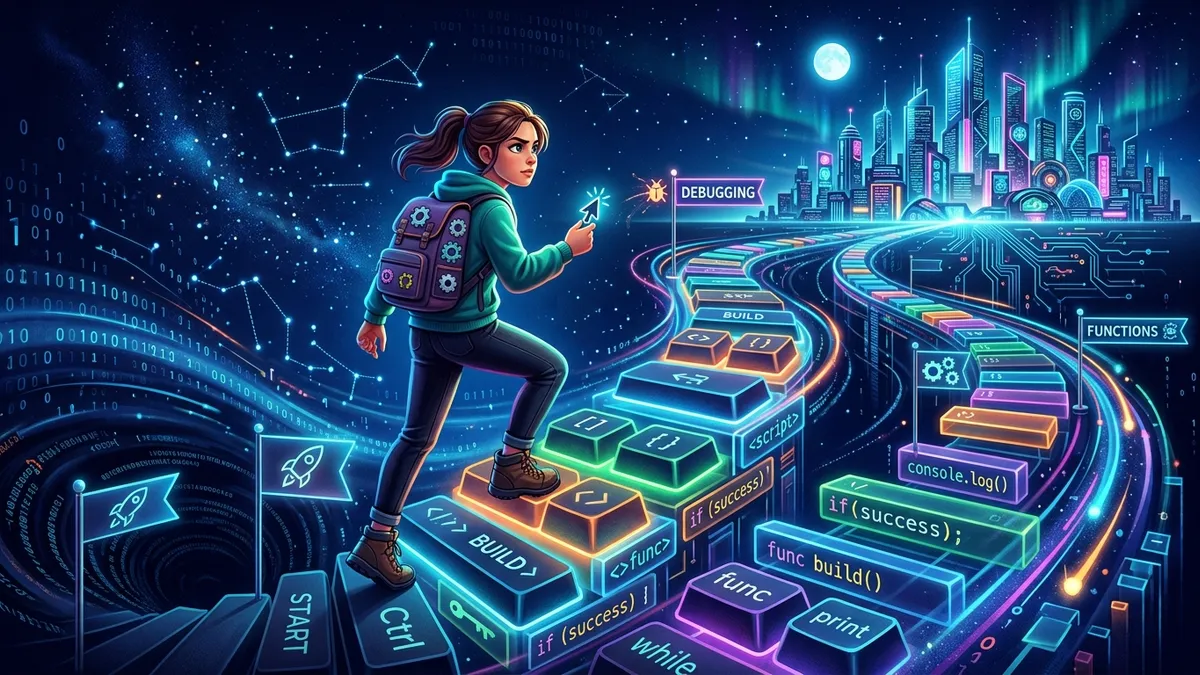
Stage 1 — Fundamentals in one language (months 1–3)
Pick Python or JavaScript and refuse to reconsider for six months. Python if data, automation or general programming attracts you; JavaScript if you want to see things on screens quickly (it’s the web’s language — and where most beginner jobs are). The choice matters less than the committing does; fundamentals transfer completely.
Learn, in order: variables and types → conditionals → loops → functions → lists/arrays and dictionaries/objects → reading errors (a skill, practice it deliberately) → breaking problems into steps. Free, excellent resources abound: freeCodeCamp, The Odin Project (JS), CS50x for the brave, the official Python tutorial. One primary resource, start to finish — resource-hopping is procrastination wearing a productivity costume.
The daily habit that changes everything: for every concept, close the tutorial and rewrite the example from memory, then change it — different inputs, an extra feature, a deliberate bug you then fix. Typing your own errors is the actual learning event. Watching someone code teaches coding the way watching swimming teaches swimming.
Stage 2 — The tutorial escape (months 3–6)
Here’s where most people quit, so let’s name the trap: tutorial hell — the comfortable loop of following guided builds forever, feeling progress, gaining none. The exit is uncomfortable by design:
Build things slightly too hard for you, without a tutorial. Start embarrassingly small — a tip calculator, a to-do list, a dice game — then climb: a personal site, a quiz app, a script that renames your files or scrapes a weather API. Stuck is the point. When stuck: read the error, print things, search, then ask AI to explain (not solve). Every unstuck moment is a permanent skill deposit.
Alongside, adopt the professional basics early, badly, and improve: Git and GitHub from month three (commit daily; our Git guide will make sense a bit later — start with add/commit/push), a real editor (VS Code with a sane extension setup), and the command line one command at a time.
Stage 3 — Depth in one domain (months 6–12)
Generalists emerge later; beginners need a lane. Pick the one whose output excites you — excitement is fuel, and this journey runs on fuel:
- Web development (largest job market): HTML/CSS properly, then JavaScript in the browser, then a backend — our Express API tutorial is the shape of it. One framework after fundamentals, not instead of them.
- Data/automation (Python lane): pandas, scripts that touch real files and APIs, a dashboard, SQL — SQL is quietly one of the highest-ROI skills in existence.
- Something weirder — game dev, hardware, mobile: smaller markets, but passion finishes projects, and finished projects get jobs.
In this stage you also earn the professional muscles: databases, HTTP and APIs, testing (write your first tests and feel the safety), deploying something to a real URL (static hosting is free — see our hosting comparison). Each of these is a week of confusion that becomes permanent capability.
Using AI without hollowing yourself out
The genuinely new part of learning in 2026. AI assistants are simultaneously the best tutor beginners have ever had and the easiest way ever invented to skip the learning. The difference is entirely in how you use them:
Do: ask for explanations of code you’re reading (“line by line, why does this work?”), ask why your fixed bug was a bug, request practice problems, have it review finished projects like a senior would (“what’s fragile here? what would a professional do differently?”), use it to decode error messages you’ve already stared at.
Don’t: paste assignments in and submit what comes out; accept code you can’t explain out loud; let autocomplete write your first thousand functions; ask it to fix errors you haven’t read. A rule that keeps you honest: for anything you’re learning (versus producing), you type every character. Understanding compounds; pasted code doesn’t. It helps to know what these tools actually are — a probabilistic text engine, brilliantly useful, occasionally confidently wrong — which is a twenty-minute read in our how LLMs work explainer.
The graduates who thrive treat AI like a tireless senior colleague: constantly consulted, never blindly trusted, and never allowed to do the reps that build the muscle.
Stage 4 — Proof of work (months 12+)
Employability is legibility: by this stage your GitHub should show two or three substantial, deployed, documented projects — not tutorial clones — plus the daily-commit texture of someone who actually builds. What makes a project “substantial,” how to present it, and how README quality changes interview odds is its own art; our junior portfolio guide covers it in depth, and the interview preparation plan picks up from there.
Frequently Asked Questions
Am I too old to learn programming? No — and the data backs the reassurance: career changers in their 30s, 40s and beyond succeed constantly, often faster than younger learners because they bring work discipline, domain knowledge and clearer motivation. The industry has an ageism problem at the hiring margins, not a learning problem; your domain expertise (finance, healthcare, logistics) plus code is frequently a stronger combination than a twenty-two-year-old’s CS degree.
Do I need a computer science degree? For most software jobs, no — portfolios and demonstrated ability carry hiring at the majority of companies, and self-taught developers are a large, normal fraction of the workforce. A degree still helps for specific doors (research, some big-company ladders, visa situations). What you do need from CS eventually: data structures, big-O intuition and how computers actually work — all learnable free, best absorbed after you can build things, when they have something to attach to.
Is a bootcamp worth it in 2026? Sometimes — as an accelerant, never as a guarantee. The good ones compress Stage 1–2 and provide structure and peers; the bad ones sell outdated curricula and inflated placement stats to exactly the people who can least afford it. Investigate ruthlessly: recent-cohort placement numbers (not marketing pages), curriculum currency (does it teach AI-era workflows?), and talk to graduates from the last six months. Everything a bootcamp teaches exists free; you’re buying pacing and accountability.
Which is better for a first language — Python or JavaScript, really? The honest answer: whichever keeps you building for six months. Python has gentler syntax and rules data/automation; JavaScript shows you visible results in a browser within minutes and owns web jobs. Flip a coin weighted by what excites you — the fundamentals transfer almost entirely, and your second language will cost a fraction of the first.
Final Thoughts
Learning to code in 2026 is a contrarian-looking bet that’s actually conservative: the world runs on software, the people who understand it deeply remain scarce, and AI raised the ceiling on what one skilled person can build while raising the floor on what counts as skilled. The path hasn’t changed shape — one language, fundamentals, the painful tutorial escape, a domain, public proof — it’s just better-lit now, with a tutor on call at 2 a.m.
Twelve to twenty-four months of unglamorous consistency. Most people won’t do it, which is precisely why it still pays for those who do. Start tonight: install Python or open a JavaScript console, write the silly calculator, make your first commit. The roadmap only works at walking pace — but it works.